Piedmont PD
  • Celebrating Piedmont
  • StudentSpace
  • Piedmont PD
  • Lesson Ideas
  • News and Thoughts

UDL 

6/8/2015

0 Comments

 
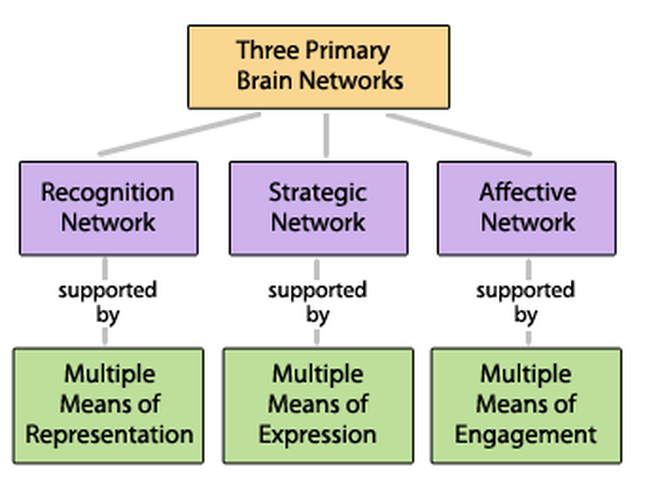
UDL stands for Universal Design for Learning. 
 It is an acronym for a system that describes good teaching similar to what we are learning in PEAK training and in IB training.Now that we are 1:1,  UDL is  perfectly suited to blend with personalized learning since it involves acknowledging each learner's uniqueness so Mr. Parkins asked me to present this brief introduction to UDL .
Picture
UDL detractors might say," Why should I retool my lessons? Isnt that coddling students? Shouldn't the students buckle up and learn now that not all teachers will accomodate their special needs?" but the role of the teacher is no longer just to dispense information. Every child has unique learning needs: gifted, special ed, and even unidentified.

 It may be that you as a student found a way to make the traditional teaching style work for your and while that is great and some of your students will find ways to work around their difficulties, why not do something proven more efficient and effective?  especially whenmany students are battling issues you may not be able to see from the outside. (please click that link to experience what some are like) 
Picture
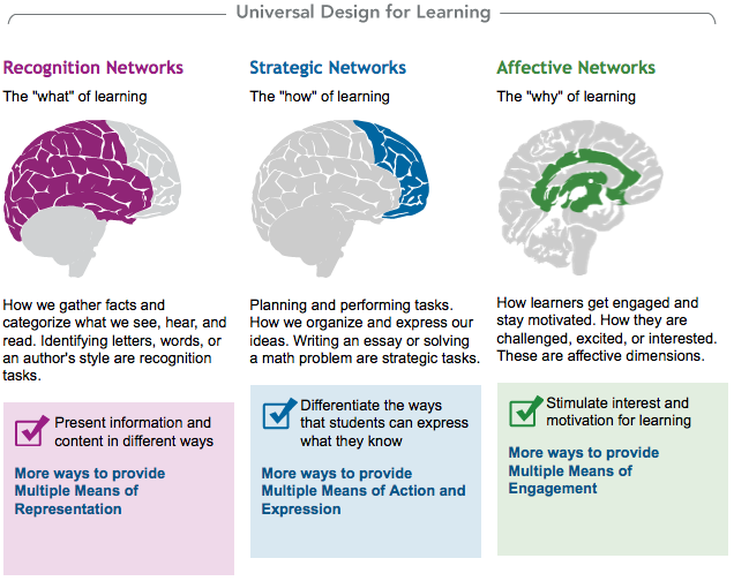
UDL teaches that, rather than writing separate lesson plans for each child (the old, incredibly time-inefficient, and possibly apocryphal definition of "differentiation"), we teachers should create lessons that appeal to all learners and incorporate differentiation via built in multiple modalites as well as choice.  

This video explains more:
UDL is IB
  • Here is a link to  IB MYP Cheat Sheet for UDL (how many acronyms can I put into one sentence?)
  • IB programme standards and practices  require schools to demonstrate their support for learning diversity 

• A9 The school supports access for students to the IB programme(s) and philosophy. 
• B1:5 The school develops and implements policies and procedures that support the programme(s). 
• B2:8 The school provides support for its students with learning and/or special educational needs and support for their teachers. 
• C1:6 Collaborative planning and reflection incorporates differentiation for students’ learning needs and styles.
 • C3:10 Teaching and learning differentiates instruction to meet students’ learning needs and styles.
Picture
Hands-on creation and choice are important UDL strategies.
    -   from http://www.ibo.org/globalassets/digital-tookit/flyers-and-artworks/inclusive-education-en.pdf

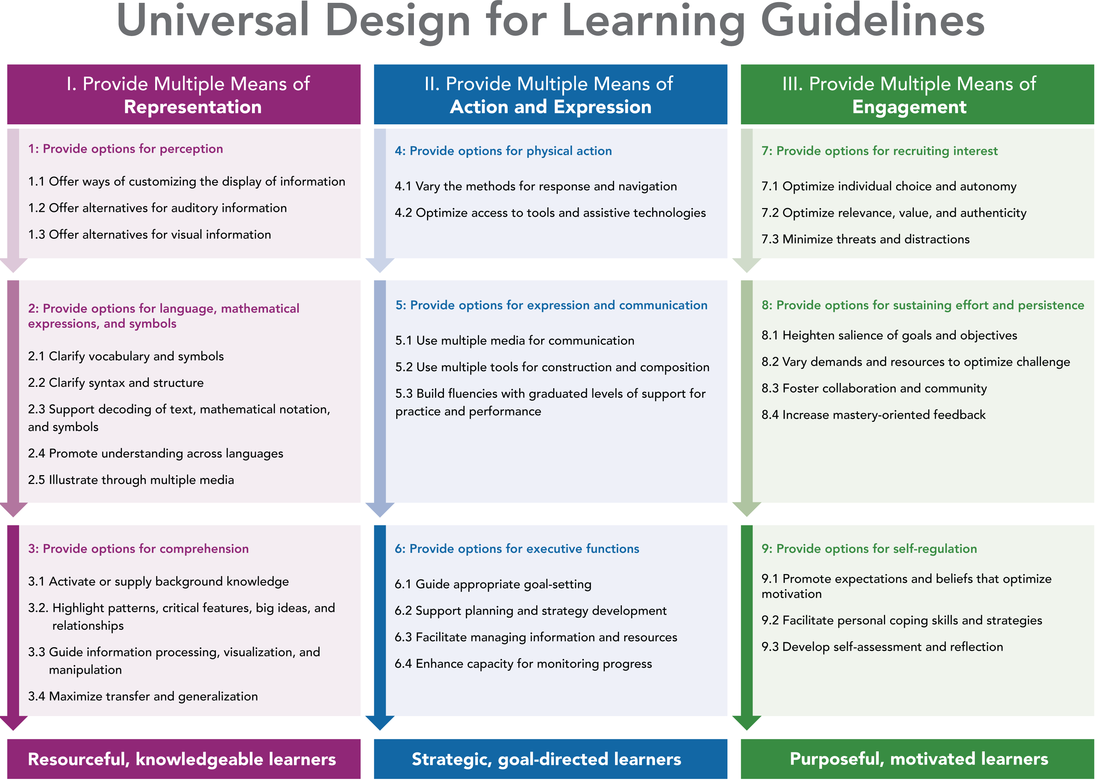
Three Principals of UDL:
Picture
Principle I. Provide Multiple Means of Representation


Guideline 1: Provide options for perception
  • Checkpoint 1.1: Offer ways of customizing the display of information [3]
  • Checkpoint 1.2: Offer alternatives for auditory information [4]
  • Checkpoint 1.3: Offer alternatives for visual information [5]

Guideline 2: Provide options for language, mathematical expressions, and symbols
  • Checkpoint 2.1: Clarify vocabulary and symbols [6]
  • Checkpoint 2.2: Clarify syntax and structure [7]
  • Checkpoint 2.3: Support decoding of text, mathematical notation, and symbols [8]
  • Checkpoint 2.4: Promote understanding across languages [9]
  • Checkpoint 2.5: Illustrate through multiple media [10]

Guideline 3: Provide options for comprehension
  • Checkpoint 3.1: Activate or supply background knowledge [11]
  • Checkpoint 3.2: Highlight patterns, critical features, big ideas, and relationships [12]
  • Checkpoint 3.3: Guide information processing, visualization, and manipulation [13]
  • Checkpoint 3.4: Maximize transfer and generalization [14]

Principle II. Provide Multiple Means of Action and Expression


Guideline 4: Provide options for physical action
  • Checkpoint 4.1: Vary the methods for response and navigation [15]
  • Checkpoint 4.2: Optimize access to tools and assistive technologies [16]

Guideline 5: Provide options for expression and communication
  • Checkpoint 5.1: Use multiple media for communication [17]
  • Checkpoint 5.2: Use multiple tools for construction and composition [18]
  • Checkpoint 5.3: Build fluencies with graduated levels of support for practice and performance [19]

Guideline 6: Provide options for executive functions
  • Checkpoint 6.1: Guide appropriate goal-setting [20]
  • Checkpoint 6.2: Support planning and strategy development [21]
  • Checkpoint 6.3: Facilitate managing information and resources [22]
  • Checkpoint 6.4: Enhance capacity for monitoring progress [23]

Principle III. Provide Multiple Means of Engagement


Guideline 7: Provide options for recruiting interest
  • Checkpoint 7.1: Optimize individual choice and autonomy [24]
  • Checkpoint 7.2: Optimize relevance, value, and authenticity [25]
  • Checkpoint 7.3: Minimize threats and distractions [26]

Guideline 8: Provide options for sustaining effort and persistence
  • Checkpoint 8.1: Heighten salience of goals and objectives [27]
  • Checkpoint 8.2: Vary demands and resources to optimize challenge [28]
  • Checkpoint 8.3: Foster collaboration and community [29]
  • Checkpoint 8.4: Increase mastery-oriented feedback [30]

Guideline 9: Provide options for self-regulation
  • Checkpoint 9.1: Promote expectations and beliefs that optimize motivation [31]
  • Checkpoint 9.2: Facilitate personal coping skills and strategies [32]
  • Checkpoint 9.3: Develop self-assessment and reflection [33]

Source URL: http://www.udlcenter.org/implementation/examples
UDL Resources for your classroom:
6 Ways to Engage Every Learner Using UDL
UDL Strategies (by content area and tool)
UDL for the ELA and Math Classroom

Further info on UDL
Main UDL website link Mr. Parkins shared

0 Comments


Leave a Reply.

    Author

    This blog is a compendium of District and Piedmont -specific PD opportunities, trainings, and notes. 
    Authored by  Lisa Gurthie 
    who specializes in creative lesson ideas especially critical, holistic, and divergent thinking, tech- and arts integration, respect- and curiosity-driven education, and unschooling school to make it more real and relevant. One day she will modernize her "about" page.

    Archives

    November 2019
    July 2019
    March 2019
    December 2018
    November 2018
    October 2018
    September 2018
    February 2018
    October 2017
    May 2017
    April 2017
    March 2017
    February 2017
    January 2017
    December 2016
    November 2016
    October 2016
    September 2016
    August 2016
    May 2016
    April 2016
    February 2016
    December 2015
    November 2015
    October 2015
    September 2015
    June 2015
    May 2015
    April 2015
    March 2015
    February 2015
    January 2015
    December 2014
    October 2014
    September 2014
    August 2014
    July 2014
    May 2014
    April 2014
    March 2014
    January 2014
    November 2013

    RSS Feed

    Categories

    All
    1:1
    2minpd
    Academic Conversation
    Badging
    Blended
    Certifications
    CMS PD
    Common Core
    Community PD
    Critical Thinking
    Culturally Responsive Teaching
    Ed Reform
    Efficiency
    ELL
    Embedding
    Flipped
    GAFE
    Games
    Google Classroom
    HardFun
    Interdisciplinary
    Maker
    Paperless
    PBL
    Personalized
    Personalized PD
    QR Code
    Reading
    Science PD
    Short URL
    SIOP
    Social Media
    Tech

Powered by Create your own unique website with customizable templates.
Photos from docoverachiever, memebinge, Ivy Dawned, www.ilkkajukarainen.fi, Muffet, Diana Boucino, Stephane .Jaspert, sanazmy97, kevin dooley, Mike Licht, NotionsCapital.com, studiohzwei, The Daring Librarian, bobbi vie, madnzany, lisibo, Tjeerd, Nicola since 1972, Brett Jordan, ~Matt LightJam {Mattia Merlo}, denise carbonell, The Lex Talionis, Toolstotal, liverpoolhls, Ninara
  • Celebrating Piedmont
  • StudentSpace
  • Piedmont PD
  • Lesson Ideas
  • News and Thoughts